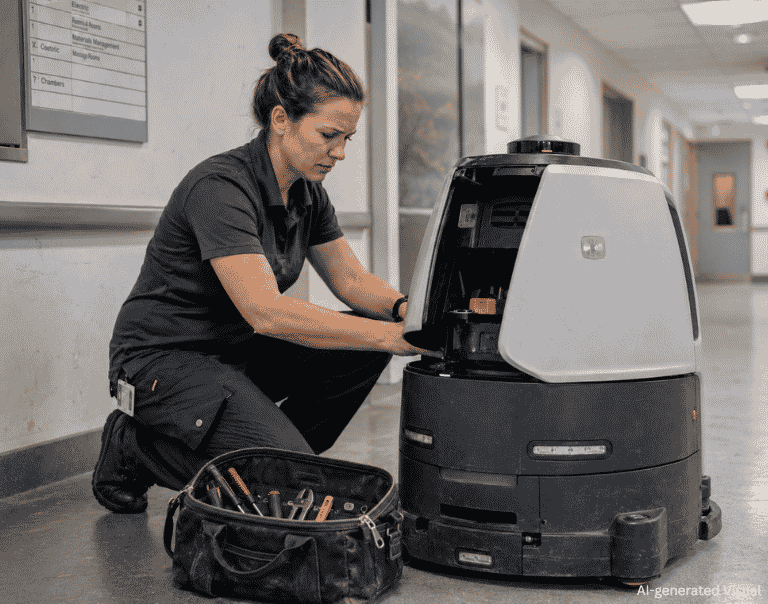
As installed bases grow, maintenance, repair and spare parts availability become increasingly critical. LPR combines…
August 28, 2026
Supporting medical technology across Europe: Spare parts logistics for maximum uptime
LPR combines late cut-off-times, international in-night delivery and integrated returns into a time-critical spare parts logistics solution for medical technology. This helps secure field service operations, manage high-value components efficiently and reduce downtime in clinical environments.

International Spare Parts Logistics for Medical Technology – Uptime as Strategic Responsibility
This discussion does not begin with logistics. It begins with the patient. Medical technology directly supports patient care. When a system fails, the issue is not transit time – it is diagnostics, treatment continuity and clinical decision-making.
For an internationally operating medical technology manufacturer, we manage time-critical spare parts logistics from a central distribution hub in Southern Germany to multiple European markets.
This is not traditional distribution. It is the operational safeguarding of a brand promise under real-time conditions.
Strategic context
The manufacturer centralises European spare parts inventory at one hub. From there, deliveries are made to national organisations, field engineers, doctors, clinics and hospitals.
Countries covered include: Germany, Austria, Switzerland, Luxembourg, Liechtenstein, Belgium, the Netherlands, France, the UK and Ireland.
This structure creates strategic tension points:
- Central inventory with decentralised responsibility
- Late service decisions
- Cross-border transit requirements
- High-value and limited-availability components
- Sensitive delivery locations
- Capital exposure through idle inventory
In this environment, uptime becomes a management issue – not merely a transport issue.
Complexity as a strategic lever
Several routes are only achievable within required timelines through combined road–air–road solutions.
Additional factors include:
- Extremely late cut-offs
- In-night delivery by 07:00
- Engineer boot and PUDO delivery
- Hospital and clinic deliveries
- Simultaneous return of high-value components
Many of these parts are expensive or limited in supply. When unused, they must return to the central hub via the fastest possible route to minimise capital exposure and maintain network availability. This is where logistics moves from operational execution to strategic capability.
Executive perspective: what is truly at stake
In medical technology, uptime affects three dimensions:
- Operational continuity
- Financial control
- Brand credibility
International spare parts logistics is therefore not a cost centre – it is a risk management instrument.
Our contribution: network stability
For this customer, we operate an integrated model combining:
- Late cut-offs
- Road–air–road execution
- Nationwide in-night delivery by 07:00
- Engineer and hospital delivery
- Structured reverse logistics of high-value components
The objective is not shipment performance alone, but network stability.
Conclusion
In medical technology, uptime is not created at dispatch. It is created through structured network design.
When centralised inventory, cross-border requirements, late service decisions and sensitive delivery environments converge, spare parts logistics becomes a leadership responsibility. And ultimately, every successful delivery supports patient care.

Related Posts